

Roofing Contractor in San Antonio, TX
5-Star Reviews
Certified Roofing Professionals
Manufacturer-backed Systems
Trusted Across San Antonio & Hill Country
Roofing Services in San Antonio, TX
Hill Country roofers working across San Antonio
Silver Horn Roofing is based in Bandera, an easy drive down Bandera Road (Highway 16), and works across San Antonio and Bexar County, from Alamo Ranch and Stone Oak to the Medical Center and Monte Vista, plus nearby cities like Helotes, Shavano Park and Alamo Heights. Every job starts with a free inspection and a written report with photos, and you deal with one team from the first inspection to the final cleanup.
Other areas we serve: Bandera, Kerrville, Boerne, New Braunfels and San Marcos.
Nearby towns we serve: Helotes, Leon Valley, Fair Oaks Ranch, Schertz and Castroville.
Why San Antonio roofs fail early
Hail
San Antonio gets frequent, damaging hail. On April 12, 2016, hail up to 4.5 inches fell across north and northwest San Antonio and Bexar County. Insured losses reached about $1.4 billion, the costliest hailstorm in Texas history at the time. Less than two weeks later, baseball-size hail hit the Shavano Park area and parts of western San Antonio.
Thousands of roofs were replaced after that storm. Those roofs are now about 10 years old and have been through many hail seasons since. Damage that is invisible from the street often shows up later as granule loss and leaks. If your home is on the north or northwest side, an inspection is worth it, even if you see nothing from the ground.
Heat
Months above 95°F dry out shingles and break down sealant. Poor attic ventilation makes it worse and drives up cooling bills. We check intake and exhaust venting on every inspection.
Sudden storms, wind and heavy rain
Spring and early summer storms bring strong straight-line winds that lift shingle edges, and sudden downpours find every weak spot in flashing, valleys and gutters. Lifted shingles let rain in long before you see a stain on the ceiling.
Picture this
A homeowner in Alamo Ranch sees a few dents on the AC unit after a spring storm and assumes the roof is fine. From the ground, the shingles look normal. Up close, an inspector finds soft spots and missing granules on the west-facing slopes. With dated photos in hand, the homeowner can file a claim within the policy's deadline instead of finding the damage a year later as a leak.
Roofs we work on in San Antonio
- Single-story and two-story homes in newer communities like Alamo Ranch and Stone Oak
- HOA neighborhoods with approved shingle colors and styles
- Older homes in Alamo Heights, Monte Vista and Olmos Park (steep pitches and redecking)
- Metal roofs on homes along the north side and the Hill Country edge
- Small commercial buildings (TPO and low-slope)
Permits, HOAs, and historic districts in San Antonio
- City permit. Inside San Antonio city limits, a residential re-roof needs a permit from the City's Development Services Department. We pull it for you.
- Nearby cities. Helotes, Leon Valley, Shavano Park, Castle Hills, Hollywood Park, Alamo Heights, and Olmos Park are separate cities with their own rules. We confirm requirements before work starts.
- HOAs. Many neighborhoods, including much of Stone Oak, Alamo Ranch, and The Dominion, have HOA rules on roof color and material. We help you prepare the submittal.
- Historic districts. In districts such as King William and Monte Vista, changing roof material usually needs approval from the City's Office of Historic Preservation. We plan for that in the timeline.
After a hailstorm: what we do
- Free inspection with photos of every damaged area.
- A written report you can share with your insurance company.
- If you want, we can be on the roof when your adjuster inspects, to show the damage we documented.
- Once your claim is settled, we schedule the work and handle the permit and HOA paperwork.
You deal with your insurance company directly. Under Texas law, a roofer doing the work cannot negotiate your claim for you, and you are responsible for paying your deductible. Most policies have a deadline for storm claims, so call soon after a storm.
Homes and roofs in San Antonio
San Antonio's housing has a median year built of 1985 in the 2019 to 2023 American Community Survey, but that middle number hides a wide spread. About 29 percent of homes date from before 1960, while roughly 31 percent went up in 2000 or later, mostly in master-planned subdivisions outside Loop 1604. Close to 59 percent of units are single-family detached houses, and a little over half of occupied homes are owner-occupied. Inside Loop 410 you find bungalows and brick ranch houses on city lots, while the far north and west lean toward two-story tract homes.
Asphalt shingles cover most homes in the city, from three-tab roofs on 1960s ranch houses to architectural shingles on newer tract homes. A house from the 1970s or 1980s is often on its second or third roof. Homes from before about 1950 frequently have plank board sheathing rather than plywood, which can change how a new roof is fastened. On newer two-story homes, the many valleys and roof-to-wall joints are where leaks usually start.
Neighborhoods we serve in San Antonio
Stone Oak
Stone Oak was planned in 1985, though building slowed during the savings and loan crisis and many homes went up from the 1990s on. A property owners association oversees the whole area, and most of its roughly 35 subdivisions also have their own HOA. Expect an architectural review step, and note that many 1990s homes are now on a second roof.
Alamo Ranch
Alamo Ranch began in 2006 on more than 3,000 acres near Highway 151, Loop 1604 and Culebra Road, with several national builders. The earliest homes are nearing 20 years old. Neighborhood HOAs, both gated and non-gated, usually want a shingle color that matches nearby homes.
Monte Vista
Monte Vista started in 1889 and was mostly built out by the 1930s, so many homes are close to a century old or more. It became a local historic district in 1975 and joined the National Register in 1998. Old roofs here often hide plank decking and steep slopes that take more care than a tract roof.
Oak Hills near the Medical Center
Oak Hills dates to the early 1950s and has one of the city's largest groups of original ranch-style homes, many on oversized lots, some over 1.5 acres. Its civic association, formed in 1982, is voluntary rather than a deed-restricted HOA, so material choices are usually more open. Low-slope ranch roofs under big oaks collect debris near the eaves.
When storms hit San Antonio
The National Weather Service office for Austin and San Antonio notes that May is often the region's biggest month for severe weather, with the hail window usually opening in March and running into June. Summer is the long stretch of heat, and dark shingles on south and west slopes take the most wear from it. Heavy rain is its own hazard, as the June 12, 2025 Beitel Creek flash flood showed, and wind-driven rain is when weak flashing shows up as ceiling stains. Book an inspection in June once the spring storms ease, and aim for replacement in fall or early winter when crews can work in cooler weather.
Best roofing materials for San Antonio homes
Class 4 impact-resistant shingles are the most common upgrade we suggest for the north and northwest sides, where hail has hit repeatedly. Many insurers offer discounts for Class 4 roofs; ask your agent. Architectural shingles remain a sound, lower-cost choice for many homes, especially where an HOA wants a uniform look. Standing seam metal suits modern infill homes and some ranch houses where no deed rules limit it, and it sheds heat well in a long summer. For flat or low-slope sections a TPO membrane is usually a better fit than shingles.
What affects roof cost in San Antonio
- Old layers and decking. Many homes inside Loop 410 have one or two older roofs to tear off, and plank decking on prewar homes may need new sheathing before shingles go on.
- Two-story tract designs. Newer homes in Stone Oak and Alamo Ranch often have steep sections, many valleys and second-story walls, which add labor, safety gear and flashing work.
- HOA and POA review. In deed-restricted areas, the approved color list or a required shingle grade can narrow your options and add a short wait before work starts.
- Historic district rules. In Monte Vista and other historic districts, matching original materials or details can cost more than a standard shingle swap.
- Mature trees and lot size. Big oaks over older ranch homes can mean trimming, extra cleanup and careful setup.
Recent roofing projects
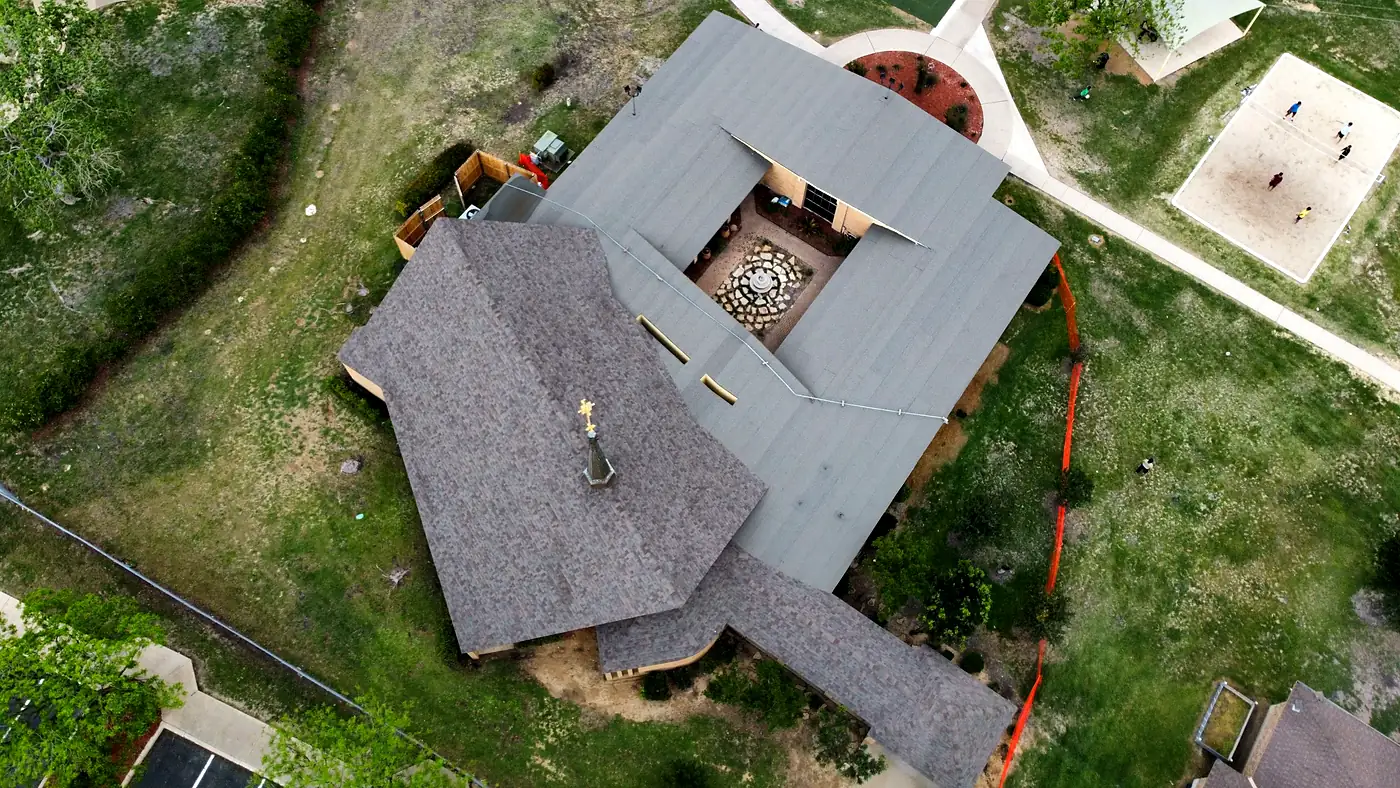
Real photos from recent Silver Horn Roofing jobs: a full re-roof on a chapel and courtyard building with shingle and low-slope sections, and an architectural shingle replacement on a large brick building.


From uncertainty to a clear solution in four simple steps
Typical Timeline:
Most projects begin within 1–2 weeks after approval.
Step 1
Inspection
Step 2
Report & Options
Step 3
Plan & Execution
Step 4
Completed System
Roofing systems built for San Antonio weather
Not all roofing materials perform equally well in South Texas. We recommend systems based on durability, efficiency, and local conditions.
The right material choice protects your home longer and can reduce your insurance premiums and energy costs.
Impact-Resistant Shingles
Class 4 impact-resistant shingles can help reduce insurance premiums and withstand hail.
Metal Roofing
Metal roofing reflects heat and lowers energy costs while providing superior wind resistance.
Complete Systems
Proper systems prevent premature failure from UV and hail damage with full ventilation and underlayment.
Energy Efficiency
Reflective materials and proper insulation reduce cooling costs in San Antonio's intense summer heat.
Why San Antonio homeowners trust our roofing company
Local expertise that matters
We understand San Antonio's hail season, HOA rules, and permits. We are a local Hill Country company, not a storm chaser, and we stand behind our work.
Honest, transparent pricing
No hidden fees. No pressure. Just clear, upfront recommendations so you can make the best decision for your home and budget.
Fast, efficient installation
Most roof replacements are completed in one day. We respect your time and keep disruption to a minimum.
Manufacturer-backed systems
We install complete roofing systems that meet the highest standards and qualify for enhanced warranties from top manufacturers.
Serving San Antonio neighborhoods and nearby cities
Based in Bandera, we work across Bexar County.
Nearby cities we serve include Helotes, Leon Valley, Shavano Park, Alamo Heights, Olmos Park, Castle Hills, Hollywood Park and Boerne.
We serve homeowners and businesses across:
Main Areas:
San Antonio Neighborhoods:
Main Areas:
What People Say About Us




Roofing Contractor San Antonio TX – FAQs
Ready to work with a trusted roofing contractor in San Antonio, TX?
Get a free inspection and a straight answer from a local Texas roofer.
